Building a GenAI Activity
There are several ways to design an assignment or activity that uses generative AI or builds literacy around it. The process outlined below uses backward design to start with what an instructor wants students to be able to do after a learning experience.
Where Might I Use GenAI?
Choose a Lesson, Learning Activity, or Assignment
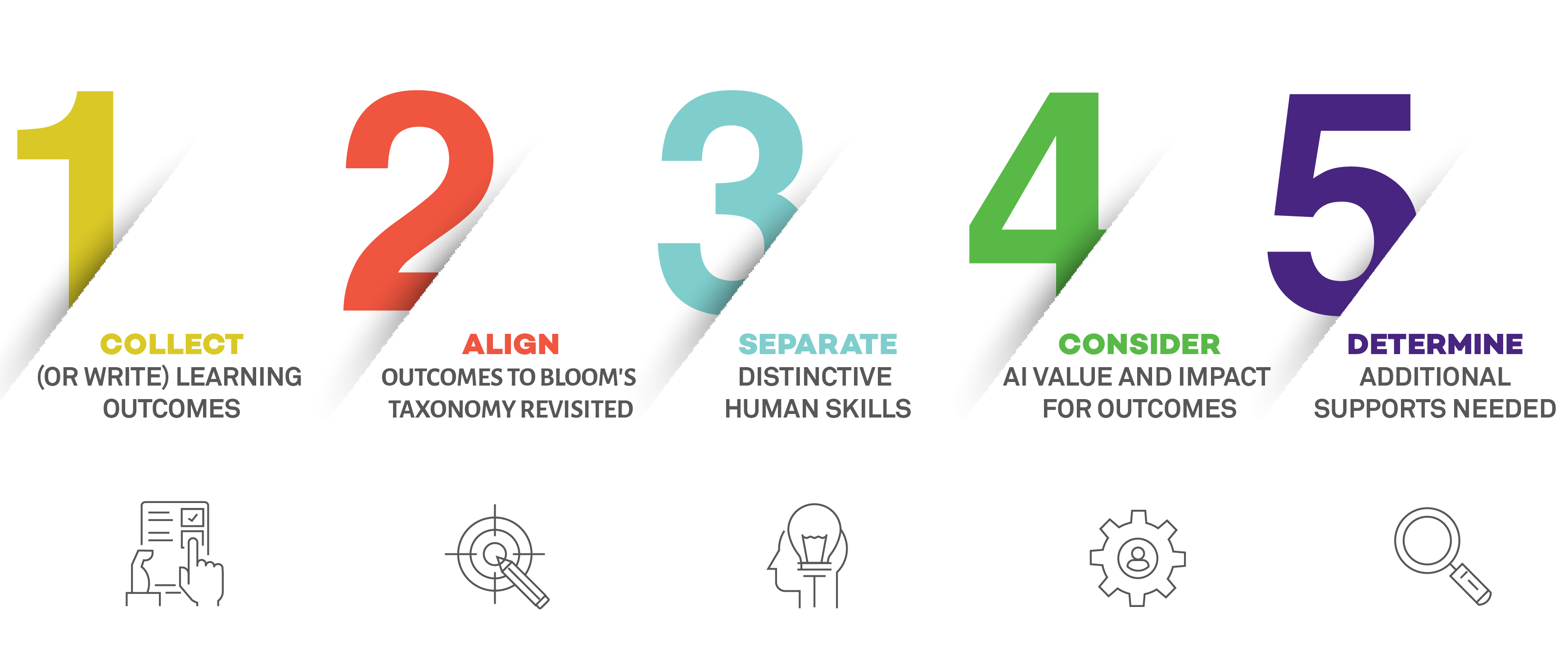
Aligning Learning Outcomes and AI Use
Step 1
Building a generative AI activity for your class can begin by aligning your learning outcomes with potential uses of AI. A good template for phrasing an outcome is:
By [time], the [audience] will [attainable verb] + [specific knowledge/skill/attitude].
For example, a learning outcome might read:
| Outcome | By the end of the first three weeks of class, first-year students will be able to select three relevant and credible sources for their midterm paper. |
|---|
If you need help getting started, use the Searle Center’s Guide to writing effective learning outcomes.
Step 2
The next step is to situate your learning outcomes with Bloom’s Taxonomy and generative AI capabilities. Bloom’s Taxonomy is an established framework to classify learning goals by complexity and specificity. Oregon State University Ecampus has created a “Bloom’s Taxonomy Revisited” guide that aligns specific generative AI capabilities with Bloom’s Taxonomy.
Begin by identifying the activity’s intended cognitive domain, the highest-level Bloom’s Taxonomy category, for each of your learning outcomes. Consult the image below or visit the Searle Center website.
Cognitive Domain: Learning Mental Knowledge and Skills
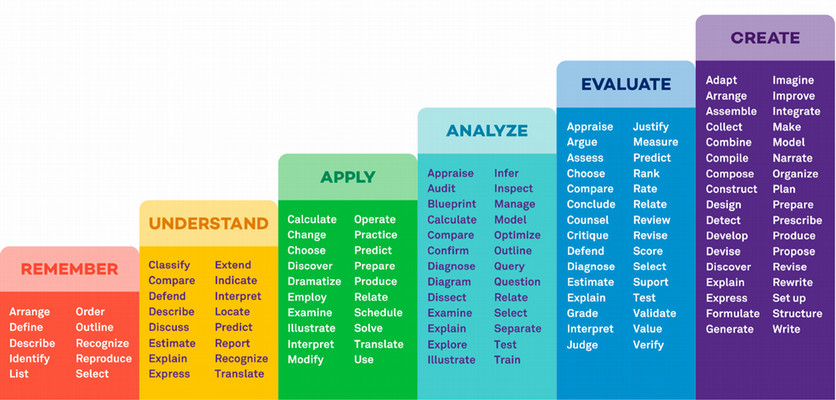
In the example, selecting sources falls under the Evaluate category. Refer to Oregon State’s Bloom’s Taxonomy Revisited guide, which lists human distinctive skills and generative AI capabilities under this category. Read through both columns of the category relevant to your outcome and reflect on any additional human or AI capabilities you might want to note.
Step 3
Separate and list the distinctive human skills your students will be developing through your activity. It might be useful to also consider these questions regarding each distinctive human skill:
- Do I provide students with opportunities to develop this skill elsewhere in the course without generative AI?
- Am I open to students using generative AI for this skill in a specific assignment or context?
- Can students also develop an AI skill as they develop this distinctive human skill?
Example:
| Outcome | By the end of the first three weeks of class, first-year students will be able to choose three relevant and credible sources for their midterm paper. |
|---|---|
| Distinctive Human Skill | Reflect on a source and evaluate its quality and relevance in the context of the midterm paper topic. |
| Considerations | I want students to identify sources that support their thesis and make those connections, a skill I want to keep distinctively human. I am open to students using AI to summarize texts in this specific assignment as they search for relevant literature, because I will have the opportunity to observe them performing this skill without AI earlier in the class. I also want them to understand how AI summaries can miss important information, so I want to make sure students read several of the sources in addition to using the AI summary. |
Step 4
The next step in aligning your learning outcomes with your AI use is to consider the potential benefits and drawbacks of students’ use of AI in the assignment.
Example:
| Outcome | By the end of the first three weeks of class, first-year students will be able to choose three relevant and credible sources for their midterm paper. |
|---|---|
| Potential Benefit | Students might feel intimidated by journal articles. Using generative AI to help explain them could reduce that barrier to entry. I'd like students to use AI to better understand a paper, rather than just summarizing it for them, which I hope will help them improve their ability to parse articles and build confidence in reading them in the future. |
| Potential Drawback | Students could simply ask generative AI for articles and/or use it to summarize sources. This could lead to reliance on inaccurate sources or to not reading the sources they use for their paper, preventing them from achieving this learning outcome; in addition, they risk not developing skills that would otherwise prepare them to be successful in the paper-writing process later in the course. |
Step 5
The final step in aligning outcomes and AI use is to determine whether students will need additional support to use generative AI for the assignment or to achieve the learning outcomes. Do you need to write any new learning outcomes that specifically address the impact of generative AI on a specific learning process? Are there any modifications to the assignment to take advantage of potential benefits or to mitigate drawbacks?
Example:
| Outcome | By the end of the first three weeks of class, first-year students will be able to choose three relevant and credible sources for their midterm paper. |
|---|---|
| Considering Students | I think my students know about using generative AI to summarize, but probably not how to use generative AI to explain concepts. I think I need to share some example prompts to show them how the two processes are different. |
| Avoiding Potential Drawback | I am concerned students might simply ask generative AI for articles and/or use it to summarize sources. We could do an in-class activity in which students share their sources with one another and assess the quality of the journal in which they were found. I might also assign a compare-and-contrast exercise in which they compare their own summaries with at least one AI-generated summary. I would also like to share an example of AI outputting a fake source or summarizing something incorrectly so they can better understand the risks. |
New Learning Outcomes
- Employ AI to explain concepts from a text that the student doesn't understand.
- Compare AI summaries of articles to their own.
- Adapt the instructor's prompts to their own research process and show that process as requested.
Additional Learning Materials
See the Heuristic for Designing Learning Experiences with Generative AI for an additional in-depth exploration of learning outcomes and generative AI.
Write, Test, Revise
Once you have aligned your learning outcomes with your AI use for your assignment, you will need to write the assignment itself.
Try the assignment yourself, or ask a colleague to try it and provide feedback. Review the output from your generative AI and assess its veracity and usefulness. As you aligned your learning outcomes, did you anticipate any of the benefits or drawbacks your students might encounter when executing the assignment? Does the exercise prompt you to revise the assignment?
As a final step in building an AI assignment for your class, consider how to solicit feedback from your students after they’ve completed it. A survey or feedback session might be useful for revising and fine-tuning the assignment for the next time you teach the class.